Conservation. Advocacy. Engagement.
Our History
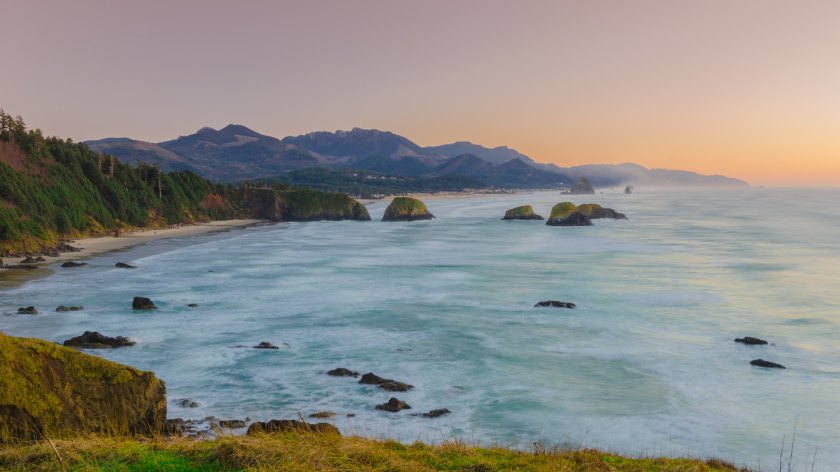
Between Cannon Beach’s spectacular coastline and the charming town is a healthy, hardworking dune system. These dunes provide a home for plants and animals, a place to recreate, and a strong defense against storms, floods and sand inundation. They’re planted with European beach grass, which is the only variety shown to strongly anchor dunes when permanent structures (condos, houses, towns) are built nearby. The beach grass, then, provides both beauty and security for the dunes and the town. Though European beach grass is an invasive, (only in that it’s from Europe,) it is a necessary compromise in developed areas to stabilize dunes.
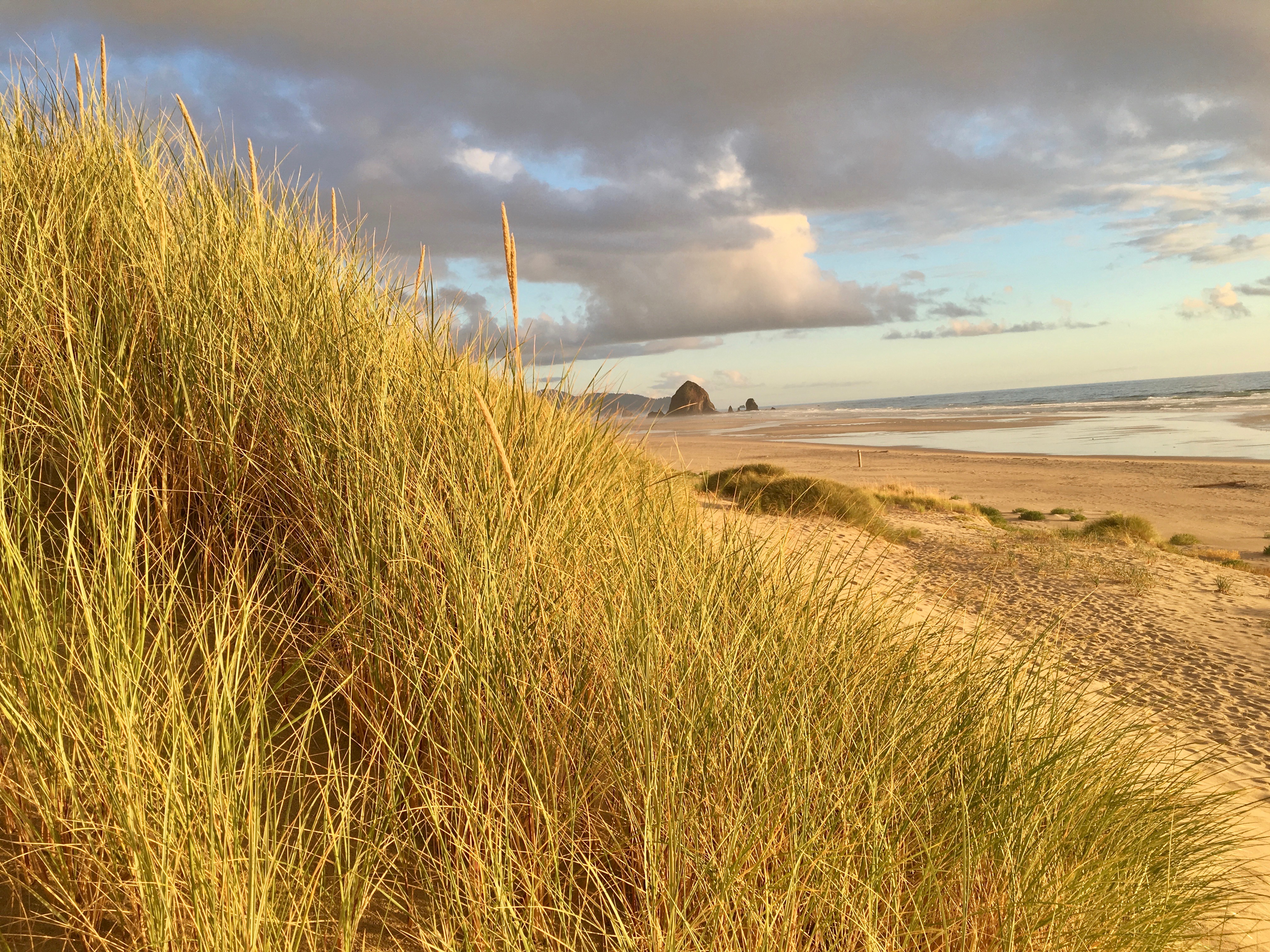 Foredunes stabilized by European beach grass.
In scientific speak, the front lines of dunes are called active foredunes. That’s because sand dunes move: they’re active. Yet for some, nature presented a problem. Up to the late 1990s, the Cannon Beach foredunes had eroded so much that residents were concerned about losing them completely, leaving the town little protection against storms. But then the sand patterns shifted, as they do, and the dunes began to grow again, especially at the northern end of town.
And so it begins
In 1998, Cannon Beach bowed to the demands of ocean-front home owners and began allowing dune grading for view enhancement. (Or as they like to say: “view restoration.” ) That year Breakers Point Homeowners Association requested, and received, permission to grade the state-owned foredunes in front of their development. They provided a small, localized sand study to the City as part of their application. Eighteen years later, that sand study was still the only one Cannon Beach used, and it was enshrined in the City’s comprehensive plan. The study was meant to have only a 10-year life.
From 1998 to 2015, the City granted multiple permits for foredune grading to Breakers Point Homeowners Association.
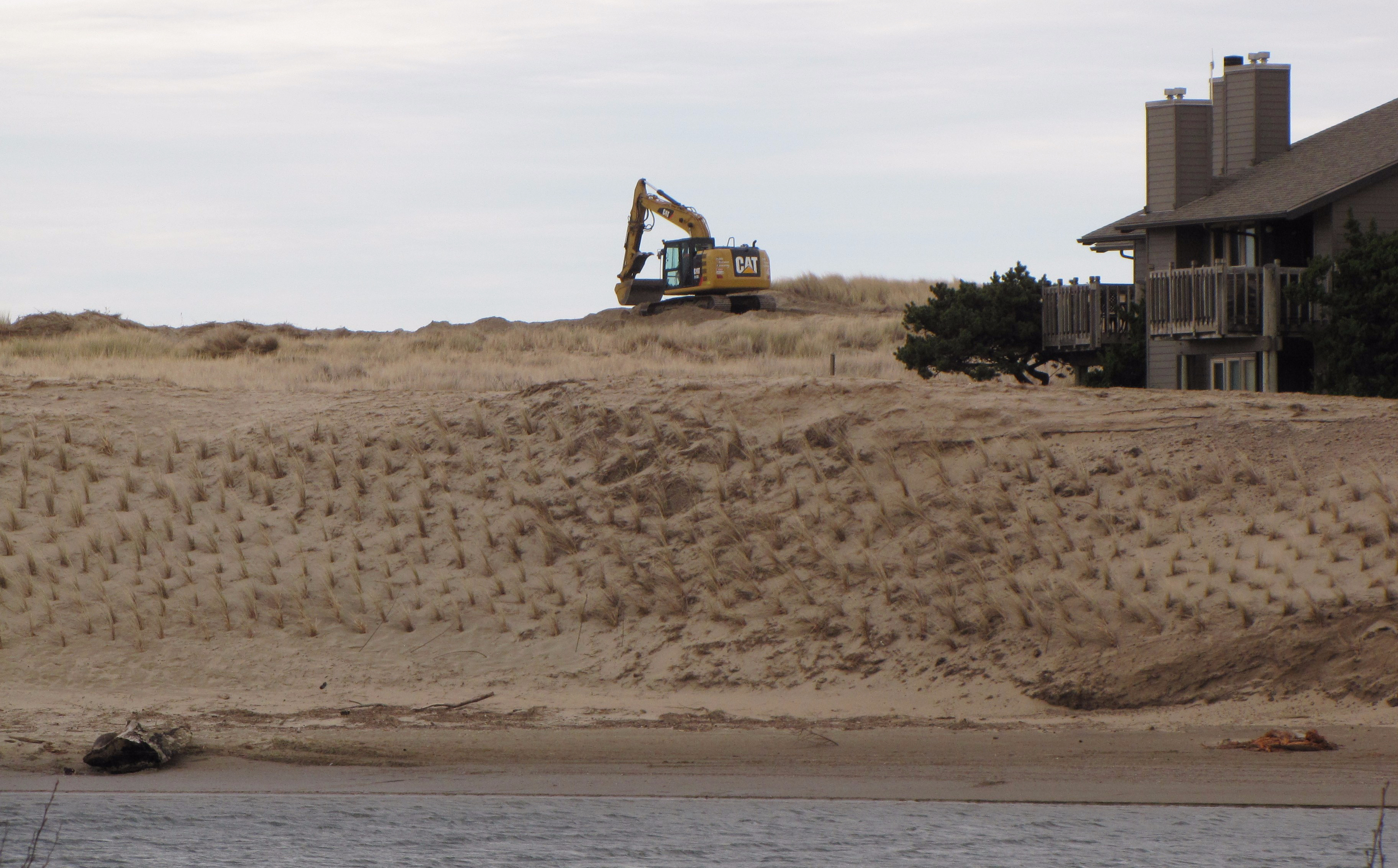
The grading requests ranged from 4,000 to 8,000 cubic yards. The unwanted graded sand was usually pushed out to the intertidal zone with hopes that it would wash out to sea, but with the knowledge that it would eventually return to the beach. We now know that this practice of sand dumping drowns the razor clams that live at the tideline.
In 2001 the Oceanside Homeowners Association, in the area know as the “Presidential Streets” also gained permission to grade the dunes in front of their houses.
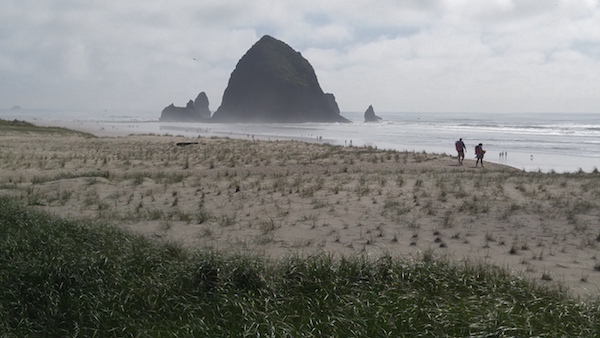 Post dune grading. An improved view for some and blight for others.
We set out to stop this destructive practice.
Flash forward to 2014 when the Chapman Point HOA requested to dune grade their pristine dunes.
That same year Breakers Point HOA requested a dune grading permit for up to 74,000 cubic yards of sand — ten times more than previously allowed! This floored the community and galvanized a group of concerned neighbors to join together to fight this land-grab of state property.
We named ourselves the Friends of the Dunes at Cannon Beach. Together with Oregon Coast Alliance (ORCA) we opposed this request. Thankfully, both the Planning Commission and City Council turned down Breakers Point’s audacious request affirming that the dunes belong to all of us and are not to be scraped and dumped to please a group of vocal property owners.
Finally, a new Foredune Management Plan
In 2016 the City began the process of updating their 20-year old Foredune Management Plan. They hired the Columbia River Estuary Task Force (CREST) to write a draft of the new Plan. Unfortunately, the City directed CREST to draft recommendations with the assumption that Cannon Beach would continue to allow dune-grading for view enhancement. This outraged the Friends of the Dunes, who expected that a policy change to disallow dune grading for view enhancement would be considered. We knew then that we would need to be heavily involved in the review process.
During what became a three-year process to update the Foredune Management Plan, there were innumerable City sponsored meetings with the community providing over a hundred hours of testimony.
An updated sand study
The City commissioned the Department of Geology and Mineral Industries (DOGAMI) to conduct an expensive study of sand movement within the entire Cannon Beach littoral cell from Cape Falcon to Chapman Point Beach. The resulting paper explained the movement of sand within the littoral cell and offered various sand management options for the City to consider. Special Paper 49, Beach and shoreline dynamics in the Cannon Beach littoral cell: Implications for dune management, by Jonathan C. Allan, Fletcher E. O’Brien, and Laura L. Gabel. Download publication (30 MB, 118 p. PDF)
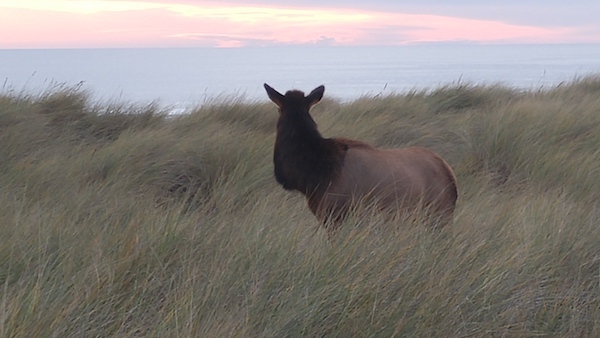 A Roosevelt elk takes in the sunset amongst the dunes at Chapman Point.
The City held multiple community information sessions where various scientist shared their expertise. Dr. Jonathan Allan PhD, the author of the Special Paper 49 on the littoral cell paper, explained his findings.
Dr. Sally Hacker PhD gave a lengthy presentation on dune grass, sharing that the invasive American Beach Grass (A. breviligulata) is becoming the dominate species in Cannon Beach, rather than the also invasive European Beach Grass (A. arenaria.) Dr. Hacker also shared the new discovery of a hybrid of the two above Beach Grasses spreading on our dunes. How this hybrid species develops and performs could have significant impacts on our ocean shore.
Dr. Hacker also explained that regardless of species, beach grass only accounts for 50% of a dune’s height. The other factors contributing to dune height and width include nearby development such as buildings, erosion-control structures (riprap, seawalls), along with sand transport and weather patterns.
Success
In 2019, after this multi-year, and contentious process, the City Council adopted the updated Foredune Management Plan, and revised the City’s Comprehensive Plan removing the ability of property owners to dune grade our state-owned land to improve their views.
The Breakers Point and Chapman Point HOAs’ immediately appealed the City’s decision to the Oregon State Land Use Board of Appeals.
On March 3, 2021, The Land Use Board of Appeals issued an opinion upholding the City of Cannon Beach’s controversial decision to end all grading of sand dunes for view protection and/or enhancement.
Victory
Seven years of continuous, and conscientious advocacy finally paid off! We thank everyone who participated in this important process along with the City staff, Planning Commission and City Councilors for their efforts and thoughtful deliberation.
But our work isn’t finished. Why? Because the dunes:
- Belong to the public, not self-concerned property owners.
- Are a valuable public asset, enjoyed by residents and visitors alike.
- Are a crucial part of the Cannon Beach economy and beauty.
- Provide a critical bulwark against storm-damage, erosion and flooding, absorbing ever-increasingly strong, king tide waves.
- Protect and provide habitat for plants and animals.
- Provide a place for recreation, relaxation and contemplation.
You can make a difference!

Join us in protecting the dunes and shoreline in Cannon Beach.
Contact us at: friendsofdunes@gmail.com
The Friends of the Dunes at Cannon Beach is a grassroots group working to protect coastal scenic beauty, biodiversity, and recreational opportunities for residents and visitors alike.
 Friends of the Dunes at Cannon Beach, Oregon